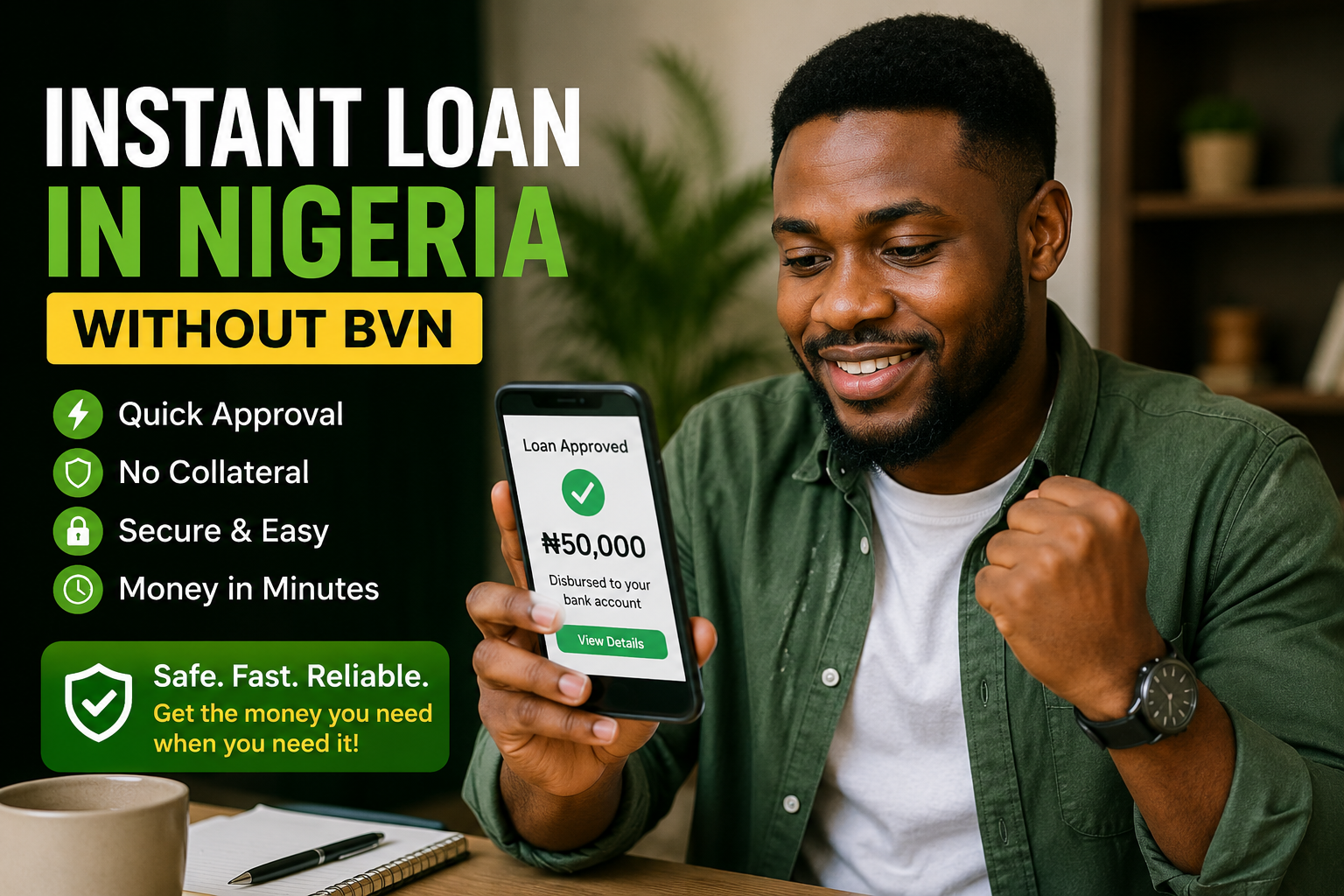
I guess you have once been in a situation where you need money urgently, perhaps your rent is due. Your child needs school fees. Your business is almost out of stock. Then you remember one problem… you need a loan don’t want to use your BVN or maybe you don’t even have access to it right now.
So you do what almost every Nigerian has done at one point or another. You pick up your phone and type: “Loan app without BVN in Nigeria.”
Within seconds, hundreds of websites and apps start promising instant loans with no BVN, no collateral, and approval in five minutes.
Sounds perfect, right? Not exactly.
The truth is that many Nigerians don’t fully understand what “getting loan without BVN” actually means. Some believe they can borrow ₦500,000 or even ₦1 million without providing any verification whatsoever. Others download random apps and end up dealing with outrageous interest rates, harassment, and privacy issues.
I’ve seen traders in Lagos install three different loan apps in one afternoon because they needed money to buy goods for their shops. I’ve also seen salary earners collect ₦20,000 and end up repaying almost double because they didn’t understand the terms.
So before you click the first app that appears on Google, there are a few things you need to know.
This guide explains:
- Whether you can really get a loan without BVN in Nigeria.
- How these loans actually work.
- The legitimate options available in 2026.
- The risks you should watch out for.
- How to improve your chances of approval.
- Safer alternatives if you don’t want to share your BVN.
If you’ve been searching for an honest answer instead of the usual “download this app and get ₦500,000 instantly” promise, keep reading.
Can You Really Get a Loan Without BVN in Nigeria?
Yes… but most legitimate lenders in Nigeria do not completely ignore BVN requirements. Instead, they may:
- Allow registration without BVN.
- Offer a small first loan without BVN.
- Use your NIN or phone data instead.
- Request your BVN later if you want higher loan limits.
Think of it this way.
If a complete stranger walked into your shop and asked you to borrow ₦100,000, you would probably want to know who they are before handing over your money.
Loan companies think the same way.
BVN helps lenders confirm your identity and reduce fraud. Because of this, most regulated financial institutions eventually ask for it, especially for bigger loans.
So when you hear someone say: “I got a loan without BVN.”
What they often mean is: “I got a small loan before the company requested my BVN,” Or that they used alternative choice like their NIN.
Why Do So Many Nigerians Want Loans Without BVN?
It may sound strange to someone outside Nigeria, but there are actually several reasons.
1. Privacy Concerns
Many people are afraid of sharing their BVN online.
And honestly, considering the number of scams happening online these days, that fear isn’t entirely unreasonable.
People worry about:
- Identity theft.
- Unauthorized access to their bank details.
- Fraudulent transactions.
- Data leaks.
2. They Don’t Have Their BVN Handy
This happens more than you think.
Someone needs money urgently and suddenly realizes they don’t remember their BVN.
The nearest bank branch might be far away, and the money is needed immediately.
3. Previous Loan Defaults
Some borrowers deliberately avoid using BVN because they have defaulted on previous loans and believe a new lender won’t find out.
Unfortunately, it rarely works that way anymore.
Many digital lenders now use alternative methods to assess borrowers.
4. They Simply Want Faster Approval
Some people believe skipping BVN means faster approval.
Sometimes that’s true for very small loans.
But for larger loans, verification is usually unavoidable.
What Exactly Is BVN and Why Is It So Important?
The Bank Verification Number (BVN) is an eleven-digit unique identity number linked to your bank accounts.
It was introduced by the Central Bank of Nigeria to strengthen customer identification and reduce banking fraud.
In simple English, your BVN tells financial institutions:
“This person is who they claim to be.”
Your BVN is linked to:
- Your name.
- Your date of birth.
- Your biometric information.
- Your banking history.
- Your credit profile.
This is why lenders love it.
It reduces the chances of lending money to someone who disappears after collecting a loan.
Can You Get Large Loans Without BVN?
Short answer?
Very unlikely.
If any app promises:
- ₦500,000 without verification
- ₦1 million instantly without BVN
- Huge business loans without identity checks
You should be extremely careful.
That’s usually where many Nigerians get into trouble.
Legitimate lenders are in business to make money, not to give strangers huge amounts of cash with zero verification.
Most no-BVN loans fall into this range:
| Loan Amount | Typical Repayment Period |
|---|---|
| ₦2,000 – ₦10,000 | 7 – 30 days |
| ₦10,000 – ₦30,000 | 14 – 60 days |
| ₦30,000 – ₦50,000 | 30 – 90 days |
Anything significantly above these figures usually comes with additional verification requirements.
How Do Loan Apps Approve People Without BVN?
This part surprises many people.
Even if an app doesn’t ask for your BVN immediately, it may still know a lot about you.
Modern loan apps use different methods to assess risk.
Your NIN
Many lenders now use your National Identification Number instead of BVN during the early stages of application.
Your Phone Number
Some apps check how long your SIM card has been active.
Your Smartphone Activity
Certain apps look at:
- Your device information.
- Your location.
- Your repayment history.
- Your account activity.
Your Banking Transactions
Some platforms request permission to view your transaction patterns.
For example, if you receive salary payments regularly, your chances of approval may increase.
READ ALSO Best Loan Apps in Nigeria with Low Interest Rates (2026)
Who Usually Qualifies for a Loan Without BVN?
You may have a better chance if you:
- Are at least 18 years old.
- Have a valid phone number.
- Possess a NIN.
- Have an active bank account.
- Can show evidence of income.
- Have a good borrowing history.
Interestingly, many small business owners qualify because they receive regular transfers from customers.
A trader in Aba selling fabrics or a foodstuff seller in Lagos who gets steady bank alerts may appear more trustworthy to digital lenders than someone with no transaction history at all.
The Biggest Mistake Nigerians Make When Looking for Loans Without BVN
Desperation.
Urgent need for money can make people ignore obvious red flags.
Someone needs ₦15,000 for rent and suddenly an app promises ₦200,000 with no verification and no questions asked.
At that point, common sense sometimes takes a small holiday.
Before applying for any loan, always ask:
- Who owns this app?
- Is the company registered?
- What interest rate will I pay?
- What happens if I miss repayment?
- Why are they asking for access to my contacts and photos?
These questions alone can save you from a lot of stress later.
Legitimate Loan Apps That May Give Small Loans Without BVN in Nigeria
Now, let’s get practical.
If you’ve read this far, you’re probably not looking for theory anymore. You’re asking a simple question:
“Which apps can actually give me money if I don’t want to use my BVN immediately?”
Fair question.
But before I start listing apps, let me say something that can save you a lot of stress.
There is a big difference between:
- Loan apps that do not ask for BVN immediately.
- Loan apps that never ask for BVN.
The second category is becoming extremely rare in Nigeria.
Why?
Because regulators have been cracking down on fraudulent lending platforms and forcing digital lenders to improve their identity verification processes. Many lenders now rely on a combination of NIN, smartphone data, and transaction history before approving loans. Some eventually ask for BVN when you want larger loan limits.
That means you should approach any app that promises huge loans without any form of verification with caution.
Now, let’s look at some of the options Nigerians are actually using in 2026.
1. PalmCredit
PalmCredit has been around for years and remains one of the most popular loan apps in Nigeria. Many first-time users report receiving small loans before being asked to submit their BVN, although requirements can vary depending on your profile and credit history.
Typical details include:
| Feature | Details |
|---|---|
| Loan Amount | ₦2,000 to ₦100,000+ |
| Repayment Period | 91 to 365 days |
| Approval Time | Few minutes to a few hours |
| Collateral | Not required |
Best for:
- Emergency expenses
- Salary bridge loans
- Small business cash flow problems
Imagine you’re a foodstuff seller in Mile 12 Market. Rice prices suddenly increase, and you need an extra ₦20,000 to buy stock before prices go up again. A small short-term loan can help you take advantage of that opportunity.
The danger comes when people borrow simply because the money is available.
Borrow because it solves a problem, not because the app approved you.
2. OKash
OKash operates within the OPay ecosystem and has become one of Nigeria’s most widely used digital lending platforms. Some first-time borrowers receive starter loans without immediate BVN verification, although higher limits usually come with additional requirements.
Typical loan features:
| Feature | Details |
|---|---|
| Loan Amount | ₦3,000 to ₦200,000 |
| Repayment Period | Up to 12 months |
| Collateral | None |
| Approval Speed | Usually within minutes |
OKash tends to work well for people who already use OPay regularly because the platform can analyse transaction patterns and build confidence in the borrower.
3. Carbon
Carbon is one of the oldest digital lending platforms in Nigeria.
One thing many people like about Carbon is that it doesn’t operate like those random apps that suddenly start calling your uncle in Enugu because you missed repayment by two days.
Carbon has built a reputation around transparency and proper lending practices.
Some new users can access entry-level loans with basic verification, although larger facilities usually require additional information.
| Feature | Details |
|---|---|
| Loan Amount | ₦2,500 to ₦1,000,000 |
| Repayment | 2 to 12 months |
| Collateral | None |
| Processing Time | Minutes |
If you’re a salary earner and your employer delays payment for a few days, Carbon is often one of the platforms people consider for short-term cash needs.
4. FairMoney
FairMoney has grown significantly over the years and now operates more like a digital bank than just a loan app.
Some users begin with minimal verification requirements and later unlock larger loan amounts as trust is built.
FairMoney can be useful if:
- You have a regular income.
- You need short-term business support.
- You want a repayment period that isn’t ridiculously short.
Many traders actually prefer longer repayment periods because their businesses may not generate profits immediately.
For example, someone importing shoes from Aba or buying foodstuff in bulk may need several weeks before turning inventory into cash.
5. Aella Credit
Aella Credit has become popular among salary earners and small business owners because it offers relatively higher loan limits to qualified borrowers. Some users can start with small loans and gradually increase their limits over time.
Think of these apps like a relationship.
The lender doesn’t know you yet.
So they start small.
If you borrow ₦10,000 and repay on time, the next offer may become ₦20,000.
From 20k to ₦50,000. Then ₦100,000.
Trust is built gradually. That’s exactly how digital lending works.
How to Apply for a Loan Without BVN Step by Step
This part is where many people make mistakes.
They download an app and start clicking buttons without reading anything.
Five minutes later, they’ve accepted a loan whose repayment terms they don’t even understand.
Please don’t do that. Here’s the smarter approach.
Related Article Best Loan Apps in Nigeria 2026 without collateral
Step 1: Download Only Trusted Apps
Start from the official website or the Google Play Store.
Never install loan apps from random WhatsApp links.
Never.
The internet is already chaotic enough without voluntarily handing your personal information to strangers.
Step 2: Read the Loan Terms
Look for:
- Interest rate
- Repayment period
- Late payment charges
- Processing fees
- Total repayment amount
This one step can save you from borrowing ₦20,000 and repaying ₦35,000.
Step 3: Create Your Account
You may be asked for:
- Name
- Phone number
- NIN
- Address
- Email address
- Employment details
Step 4: Request Your Loan
Choose only the amount you genuinely need.
This is where discipline matters.
If you need ₦15,000 for school fees, don’t borrow ₦50,000 simply because the app approved it.
That’s how many people accidentally create financial problems for themselves.
Step 5: Accept Only If the Terms Make Sense
Read the repayment amount again.
Then ask yourself one question:
“Can I comfortably repay this loan on time?”
If the answer is no, close the app.
Seriously.
Peace of mind is also a financial asset.
How to Increase Your Chances of Approval
Many Nigerians assume loan approvals happen randomly. They don’t.
Lenders are looking for signs that you can repay.
You improve your chances if you:
- Use your real information.
- Maintain an active phone number.
- Have regular transactions in your bank account.
- Repay previous loans on time.
- Avoid applying for ten different loans in one day.
Think about it from the lender’s perspective.
If somebody applies for loans from seven apps within one hour, it usually signals financial distress.
And lenders don’t like distress.
Should You Use Loan Apps for Everyday Expenses?
This is where I become your slightly annoying teacher for a moment. No.
You should avoid using loan apps for:
- Buying clothes.
- Throwing parties.
- Weekend enjoyment.
- Impulse purchases.
Digital loans are best used for:
- Business opportunities.
- Emergency medical expenses.
- Short-term cash flow problems.
- Unexpected bills.
Borrowing for enjoyment creates temporary happiness and long-term repayment stress.
Many Nigerians have unfortunately learned this lesson the hard way.
If you’re considering a loan, it can also help to understand how digital lenders calculate repayment costs and your credit profile. The official website of the Nigerian Consumer Credit Corporation (CREDICORP) provides useful information on responsible borrowing and consumer credit initiatives in Nigeria.
You should also check whether a lender is operating legally. The Federal Competition and Consumer Protection Commission (FCCPC) regularly publishes information about approved digital lenders and consumer protection guidelines. This is particularly important because Nigeria has experienced a rise in predatory lending apps and privacy violations in recent years.
In the next section, we’ll talk about the dark side of borrowing without BVN, including fake loan apps, hidden charges, harassment tactics, and the red flags that can save you from turning a small emergency loan into a very expensive mistake.
The Dark Side of Getting a Loan Without BVN in Nigeria
Over the last few years, thousands of Nigerians have downloaded loan apps hoping to solve one financial problem, only to end up creating several new ones. Some borrowed ₦10,000 and suddenly found themselves battling hidden charges, harassment, and endless phone calls.
Others discovered that the app they downloaded wasn’t even properly registered.
So before you apply for any loan without BVN, you need to understand what can go wrong and, more importantly, how to protect yourself.
Not Every Loan App Is Your Friend
This may sound obvious, but when money is urgently needed, people often ignore warning signs.
Imagine it’s the end of the month. Your salary is delayed, your landlord is asking questions, and your electricity units are almost finished. Then you see an advert saying:
“Get ₦500,000 instantly without BVN, without collateral, and without documentation.”
At that moment, the offer may look like an answered prayer.
However, this is exactly where many people get into trouble because legitimate lenders are still businesses. They need a way to verify borrowers and reduce their risk. Therefore, if an app promises huge amounts of money with absolutely no checks whatsoever, you should immediately become suspicious.
As the saying goes, when something looks too good to be true, it usually is.
Hidden Charges Can Turn a Small Loan Into an Expensive One
This is one of the biggest complaints Nigerians have about some digital lenders.
You apply for ₦20,000 because you need money urgently, and after approval, only ₦17,000 enters your account because the lender has already deducted processing fees and other charges.
Then, two weeks later, you’re expected to repay ₦24,000.
At that point, you begin asking yourself:
“Did I really borrow ₦20,000 or ₦17,000?”
Sadly, this happens more often than people realize.
That is why you should never focus only on the amount being offered. Instead, pay attention to:
- The amount that will actually enter your account.
- The total amount you’ll repay.
- The repayment deadline.
- The late payment charges.
Those four things matter far more than the advertised loan amount.
The Problem of Extremely Short Repayment Periods
Some lenders expect repayment within seven days or fourteen days.
Now think about that carefully.
If you borrow because your business is struggling, can you realistically make enough profit within one week to repay the loan comfortably?
Sometimes the answer is yes.
But many times, the answer is no.
Take a small trader who buys bags of rice in bulk. The trader may need several weeks to sell enough stock and recover the investment. If the loan becomes due before the sales happen, repayment suddenly becomes difficult.
This is one reason why many people end up borrowing from one app to repay another.
And once that cycle starts, it can become incredibly difficult to escape.
READ ALSO OPAY vs PALMPAY vs MONIEPOINT: Which is better in Nigeria in 2026
The Dangerous Cycle of Borrowing to Repay Borrowing
Let’s talk about this because it happens every day.
Suppose Chinedu borrows ₦20,000 from one app to restock his phone accessories business. Unfortunately, sales are slower than expected and repayment day arrives.
Since he doesn’t have enough money, he downloads another app and borrows ₦25,000 to settle the first loan.
Two weeks later, the second loan becomes due.
He borrows again.
Then again.
Before long, he has loans from four different apps and spends most of his income servicing debt.
This is called a debt cycle, and it traps more Nigerians than many people realize.
Digital loans should solve temporary financial problems, not become a permanent source of income.
Some Loan Apps Use Harassment Tactics
This issue became so serious that Nigerian regulators had to step in.
Over the years, numerous borrowers complained that certain loan apps were:
- Sending embarrassing messages to contacts.
- Threatening users.
- Publishing personal information.
- Using intimidation tactics to recover debts.
Because of these complaints, the Federal Competition and Consumer Protection Commission (FCCPC) introduced regulations and began approving digital lenders that meet certain standards.
Before using any loan app, it is worth checking whether the company is properly registered and operating legally.
Doing a few minutes of research today can save you months of stress later.
Be Careful About App Permissions
This is another area where many people simply keep pressing “Allow” without reading anything.
The app requests access to:
- Your contacts.
- Your photos.
- Your messages.
- Your location.
- Your files.
And because you’re focused on getting money quickly, you approve everything.
Then you wonder later why the app seems to know so much about you.
Whenever you’re installing a financial application, ask yourself one simple question:
“Why does this lender need access to this information?”
If the answer isn’t obvious, take a step back and investigate further.
Red Flags That Should Make You Run Immediately
There are certain signs that should instantly raise suspicion.
If you notice these, it may be safer to avoid the lender entirely.
- Promises of huge loans with no verification.
- No company website.
- No customer service information.
- Pressure to borrow immediately.
- No clear explanation of interest rates.
- No privacy policy.
- Numerous online complaints.
Whenever several of these warning signs appear together, it’s usually better to walk away.
After all, there are legitimate lenders available, so there is no need to gamble with your personal information.
How to Know Whether a Loan App Is Legitimate
Fortunately, checking a lender’s credibility has become easier than before.
You can:
- Read user reviews on Google Play Store.
- Search for complaints online.
- Visit the company’s official website.
- Check if the lender complies with Nigerian regulations.
- Read the privacy policy carefully.
You can also visit the Central Bank of Nigeria website and the FCCPC digital lenders page to stay informed about developments affecting digital lending in Nigeria.
What Happens If You Fail to Repay a Loan?
This is another question many people ask after borrowing instead of before borrowing.
Depending on the lender, several things may happen.
- You may be charged late fees.
- Your credit profile may be affected.
- You may lose access to future loans.
- Collection activities may begin.
Nowadays, many lenders share data with credit reporting systems, which means failing to repay a loan can make it harder to obtain financing in the future.
This is especially important for entrepreneurs because one day you may need a larger business loan, and your borrowing history could influence that decision.
Should You Ever Take a Loan Without BVN?
The answer depends entirely on why you need the money.
If the loan will help you solve a genuine emergency or create an opportunity that can realistically generate income, then a small short-term loan may make sense.
However, if you’re borrowing simply because money is tight every month, then the loan may only postpone the underlying problem rather than solve it.
Borrowing is a financial tool, just like a knife in the kitchen. Used properly, it can be incredibly helpful. Used carelessly, it can create problems that last much longer than the emergency that caused the borrowing in the first place.
Safer Alternatives to Getting a Loan Without BVN in Nigeria
At this point, you probably have a better understanding of how no-BVN loans work and the risks that come with them. However, here’s something many financial experts will tell you: sometimes the best loan is the one you don’t have to take.
I know that statement can sound unrealistic, especially when you’re facing an emergency and your account balance is staring at you like an abandoned construction project. Life happens. School fees show up. Medical bills arrive unexpectedly. Business opportunities don’t always wait until payday.
Still, before downloading another loan app, it’s worth considering a few alternatives that may cost you less money and save you a lot of stress in the long run.
1. Salary Advance Apps and Employer Salary Advances
If you’re employed, one option is to ask whether your company offers salary advances.
Some employers allow workers to access part of their salary before payday, particularly if the need is genuine.
Think about it this way.
If your employer can give you ₦30,000 from your already earned salary, why borrow ₦30,000 from a lender and repay ₦40,000 later?
Not every company offers this benefit, but many businesses are becoming more flexible because they understand that employees occasionally face financial emergencies.
Some digital platforms also provide salary advance services based on your income history and employment records.
2. Cooperative Societies (Thrift and Savings Groups)
Nigerians have been solving financial problems through cooperative societies long before loan apps became popular.
Your parents probably belonged to one.
Your market association may even have one right now.
These cooperatives allow members to save regularly and borrow from the collective pool when needed.
Many traders use this system because:
- The interest rates are often lower.
- The repayment terms can be more flexible.
- The process is based on trust and community.
- You gradually build a savings culture.
For example, many foodstuff traders in Lagos and Onitsha rely heavily on cooperative loans to increase their inventory during festive seasons when demand rises.
Sometimes the old methods survive because they actually work.
3. Borrowing From Family or Trusted Friends
I know. Nobody enjoys having this conversation.
Asking someone for financial help can feel uncomfortable.
However, depending on your relationship and the amount involved, borrowing from a trusted family member may be significantly cheaper than using a high-interest loan app.
Of course, there is one important condition.
Pay the money back.
Nothing damages relationships faster than turning borrowed money into a permanent gift.
Many friendships have ended over amounts that wouldn’t even buy a new smartphone today.
4. Emergency Savings
This advice is not particularly exciting because it requires patience and discipline. Humans generally prefer solutions that happen in five minutes with an approval notification and celebratory sound effects.
Still, building an emergency fund remains one of the best financial habits you can develop.
Read this guide to know how to build emergency Funds in Nigeria
You don’t need to save millions.
Even setting aside ₦2,000 or ₦5,000 regularly can gradually create a financial cushion.
Over time, that emergency fund may become the reason you don’t need to borrow for every unexpected expense.
5. Credit Unions and Microfinance Banks
Microfinance banks continue to play an important role in helping small businesses and low-income earners access credit.
Unlike many digital loan apps, some microfinance institutions offer:
- Longer repayment periods.
- More personalized support.
- Business-focused loans.
- Structured repayment plans.
If you’re an entrepreneur, this option may actually suit you better than taking multiple short-term digital loans.
You can learn more about financial inclusion initiatives and regulated financial institutions through the Central Bank of Nigeria, which provides information on Nigeria’s banking and financial sector.
How to Borrow Responsibly If You Eventually Decide to Take a Loan
Sometimes, despite all the alternatives, borrowing still becomes necessary.
That’s perfectly understandable.
The key is to borrow intelligently.
Before accepting any loan offer, ask yourself these five questions:
| Question | Why It Matters |
|---|---|
| Do I genuinely need this money? | Prevents unnecessary borrowing. |
| Can I repay comfortably? | Reduces financial stress. |
| Do I understand the total cost? | Avoids unpleasant surprises. |
| Is this lender legitimate? | Protects your privacy and finances. |
| Will this loan improve my situation? | Prevents debt cycles. |
These questions may seem simple, but they can completely change your decision-making process.
Common Mistakes Nigerians Make When Borrowing Money
Over the years, certain mistakes keep repeating themselves.
Some people:
- Borrow without reading the terms.
- Take loans for non-essential spending.
- Apply to multiple lenders at the same time.
- Ignore repayment deadlines.
- Borrow to repay another loan.
- Assume future income will solve today’s debt.
Financial decisions made under pressure often create even bigger pressure later.
That doesn’t mean you should never borrow. It simply means you should borrow with a plan.
Can You Build Your Credit Profile Without BVN?
To some extent, yes.
Several lenders now use alternative data, including:
- Repayment history.
- Transaction patterns.
- Phone activity.
- Employment information.
- Digital banking behaviour.
However, as Nigeria’s financial system becomes increasingly digital, proper identification and credit history are becoming more important.
The government is also pushing initiatives aimed at improving access to responsible credit. One of these initiatives is being coordinated by the Nigerian Consumer Credit Corporation (CREDICORP), which seeks to expand consumer credit opportunities across the country.
Frequently Asked Questions
Can I get a loan without BVN and without collateral?
Yes, but the loan amount is usually small and the lender may still require other forms of verification.
Can I borrow ₦500,000 without BVN?
It is highly unlikely through legitimate lenders. Most large loans require additional identity verification.
Will loan apps ask for my BVN later?
Many of them do, especially when you want larger loan limits or additional services.
Can I use someone else’s BVN?
No. Doing so may violate lending policies and could create legal and financial complications.
Are all no-BVN loan apps scams?
No. However, some operate irresponsibly, which is why you should research any lender carefully before borrowing.
Final Thoughts
Getting a loan without BVN in Nigeria is possible, but it isn’t the magical shortcut that many advertisements make it seem.
Most legitimate lenders still need some way to verify who you are, assess your ability to repay, and reduce the risk of fraud. Because of this, completely anonymous borrowing is becoming increasingly rare.
If you decide to take a no-BVN loan, treat it as a financial tool rather than free money. Borrow only what you genuinely need, understand the repayment terms completely, and avoid taking loans simply because an app says you’re eligible.
Money problems can feel urgent, and sometimes borrowing becomes necessary. However, making informed decisions today can prevent much bigger financial headaches tomorrow.
After all, the goal isn’t just to get approved for a loan. The real goal is to solve your financial problem without creating a new one in the process.