
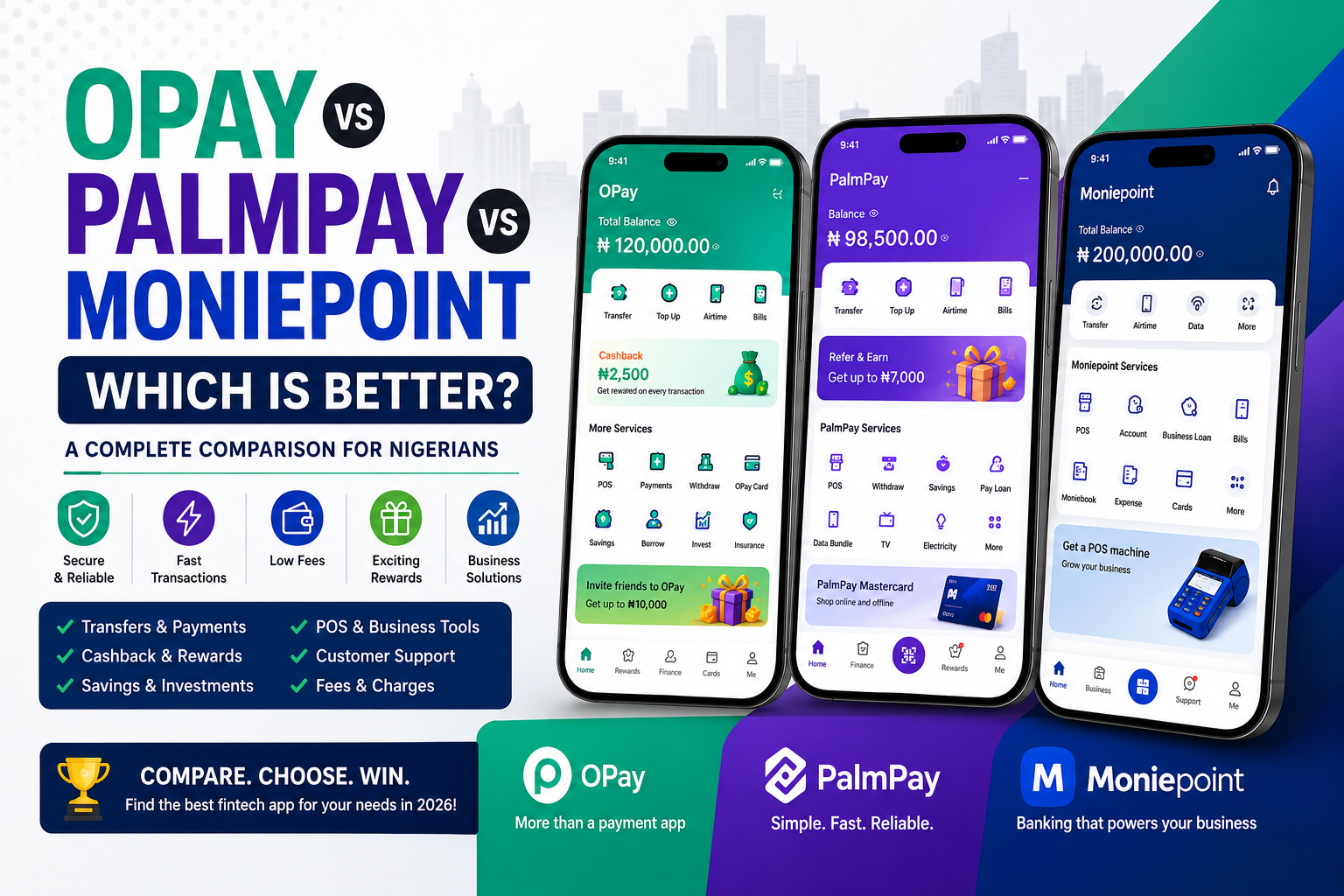
If someone had told Nigerians ten years ago that millions of people would trust an app more than their traditional bank, many people would have laughed.
Back then, if you wanted to transfer money, you had to visit a bank. If you had a complaint, you joined a long queue and waited for your turn. Even something as simple as checking your account balance sometimes meant dialing a USSD code and praying that the network would cooperate.
Things have changed so much since then.
Today, many Nigerians don’t even remember the last time they entered a banking hall. Their entire financial life happens on their phones. They receive salaries, send money to family members, buy airtime, pay electricity bills, and even run businesses without stepping inside a bank.
And if we’re being honest, three names keep showing up almost everywhere:
- Opay
- PalmPay
- Moniepoint
You see their signboards in your street. Their POS agents in markets. Or you hear people talking about them in buses and offices.
One person will tell you, “Use Opay, their transfers are fast.”
Another person will say, “PalmPay gives me cashback every time.”
Then somebody else will insist, “Moniepoint hardly fails.”
The funny thing is that all three people can be correct at the same time.
That is because these apps may look similar on the surface, but they were built with different priorities in mind.
Choosing between them is a bit like choosing between three different cars. All of them can take you from Abuja to Lagos, but one may be more comfortable, another may consume less fuel, while another may be better for carrying goods.
The same thing applies here.
The app that is perfect for a student may not be the best option for a trader in Onitsha. The app that works well for a salary earner may not meet the needs of a POS agent handling millions of naira every month.
That is why saying, “This app is the best,” without understanding your needs can be misleading.
Why Fintech Apps Became So Popular in Nigeria
To understand why Opay, PalmPay, and Moniepoint became so successful, we need to talk about the problems Nigerians were already facing.
For many years, traditional banking in Nigeria came with several frustrations.
You could enter a bank by 10 a.m. and still be there at noon.
You could make a transfer and the money would disappear
for hours before reversing.
You could call customer care and spend thirty minutes listening to music while waiting for an agent.
And then there were ATM issues.
Almost every Nigerian has experienced that painful moment when an ATM debits your account without giving you cash.
Because of these frustrations, many people were ready for something different.
That opportunity opened the door for fintech companies.
Instead of asking people to come to a physical branch, these companies decided to bring banking directly to people’s phones.
You could open an account in minutes.
Transfer money without paying heavy charges.
You could pay bills from your room.
You could even become a POS agent and start a small business with little capital.
It was convenient, and Nigerians love convenience.
According to the Central Bank of Nigeria (CBN) and the Nigeria Inter-Bank Settlement System (NIBSS), digital payments continue to grow rapidly every year because more Nigerians are embracing financial technology solutions.
Today, fintech apps are no longer alternatives to banks.
For millions of Nigerians, they have become the primary bank.
What Exactly Is Opay?
Opay is a digital financial platform that allows users to save money, transfer funds, pay bills, receive payments, and access other financial services from their mobile phones.
When Opay first entered Nigeria, many people knew it because of its motorcycle and transport business. However, the company gradually shifted its attention to financial services, and that decision changed everything.
Today, it is one of the biggest fintech companies in the country.
Think about your own neighbourhood.
There is a high chance that within a five-minute walk, you will find an Opay POS agent.
That massive presence is not accidental.
Related Article Best Dollar Virtual Cards in Nigeria for International Payments
Opay invested heavily in building an agent network because they understood something important about Nigerians. Even though digital banking is growing, many people still need physical locations where they can withdraw cash, deposit money, and solve simple issues.
Because of this strategy, the company grew rapidly.
Who Is Opay Really For?
Opay is almost like an all-purpose banking app.
If you are a student, the free transfers can help you save money.
As a salary earner, the app is simple and easy to use.
If you run a small business, collecting payments and transferring money is usually straightforward.
And if you are somebody who simply wants a banking app that works without too much complexity, Opay does a decent job.
However, it is not perfect.
Some users complain about account restrictions, while others mention customer service delays.
That doesn’t mean the app is bad. It simply means that every financial app comes with strengths and weaknesses.
What Exactly Is PalmPay?
PalmPay entered the Nigerian market with a completely different strategy.
Instead of focusing only on payments, it focused on rewards.
And honestly, that was a brilliant move because Nigerians love getting something extra.
Imagine buying airtime and receiving cashback.
Then you pay your electricity bill and get another reward.
Then you make a transfer and earn points again.
Even if the rewards are small, people still enjoy that feeling of getting value back.
That is one of the major reasons PalmPay became popular so quickly.
For students and young professionals especially, every naira counts.
Saving ₦100 here and ₦200 there may not seem like much initially, but over several months, it can become meaningful.
Who Is PalmPay Best For?
PalmPay is particularly attractive to people who perform many small transactions every day.
If you regularly buy airtime, subscribe to data plans, pay utility bills, and transfer money frequently, you may enjoy the reward system.
It is also attractive to people who simply enjoy promotions and cashback offers.
After all, if two apps can perform the same transaction and one gives you a little reward for doing it, most people will naturally choose the second one.
What Exactly Is Moniepoint?
Moniepoint is a little different from the other two.
While Opay and PalmPay focused heavily on everyday users, Moniepoint became famous by serving businesses.
This is why you’ll see Moniepoint POS machines almost everywhere.
Visit a busy market in Lagos, Aba, Kano, or Onitsha, and you’ll probably see several traders using Moniepoint.
The reason is simple.
Business owners care deeply about reliability.
If your POS machine stops working for two hours, you can lose customers and sales. If transfers keep failing, your business suffers.
Because of this, many merchants prefer platforms that have a strong reputation for transaction stability.
Moniepoint built its brand around that idea.
Who Is Moniepoint Best For?
Moniepoint is excellent for:
- POS agents
- Shop owners
- Small businesses
- Entrepreneurs
- Merchants handling large transaction volumes
That doesn’t mean ordinary users cannot use it. They can. However, its strongest features are designed with businesses in mind.
So Which One Should You Choose?
At this stage, it may be tempting to ask which one is the winner.
The truth is that we haven’t even started the real comparison yet.
Right now, we have only looked at what each app was built to do.
The real battle begins when we compare things Nigerians actually care about every day:
- Which one charges less?
- Which one gives better rewards?
- Which one fails less often?
- Which one has better customer support?
- Which one is safer?
- Which one is better for businesses?
- Which one is best for ordinary users?
And interestingly, the answer changes depending on who is asking the question.
READ ALSO How to Protect Your Money From Inflation in 2026
Opay vs PalmPay vs Moniepoint: Opening an Account and Getting Started
Let’s start with something that many Nigerians don’t pay attention to until they actually need it.
How easy is it to open an account?
This may sound like a small thing, but imagine downloading an app because you urgently need to receive money, and then the registration process starts asking for twenty different things before you can even use the account. At that moment, you begin to appreciate simplicity.
The good thing is that all three apps have made account opening much easier than traditional banks.
In fact, you can open an account on any of these platforms within a few minutes as long as you have:
- A phone number
- Your BVN
- A valid means of identification for higher transaction limits
However, the experience isn’t exactly the same.
Opening an Opay Account
Opay has one of the simplest onboarding processes in Nigeria.
You download the app, enter your phone number, verify your identity, and your account is almost ready immediately.
For many people, this speed is one reason they like the platform.
If you’re a university student who just turned eighteen and wants to start receiving money from home, you can literally open an account in a few minutes.
If you’re a small business owner who suddenly needs another bank account because your traditional bank’s app is having issues, Opay makes the process painless.
The company also allows users to upgrade their accounts by completing additional verification requirements.
Opening a PalmPay Account
PalmPay’s registration process is also straightforward and feels very beginner-friendly.
The app guides you step by step, and the interface is simple enough for someone who isn’t particularly good with technology.
One thing many new users appreciate is that PalmPay explains certain features as you register, so you don’t feel lost while setting up your account.
That may not sound important, but there are many Nigerians who are using fintech apps for the first time. For them, simplicity matters.
Opening a Moniepoint Account
Moniepoint has become much more accessible to individual users than it was a few years ago. However, the platform still feels like it was built with businesses in mind.
If you’re a merchant or someone planning to run a business account, you’ll likely appreciate the additional tools available.
For an ordinary user who simply wants a place to save money and make transfers, the setup process may feel slightly more business-oriented than Opay or PalmPay.
Winner for Easy Account Opening
All three apps perform well here, but for pure simplicity and speed:
- Opay
- PalmPay
- Moniepoint
The difference isn’t huge, but Opay and PalmPay feel slightly easier for complete beginners.
Opay vs PalmPay vs Moniepoint Transfer Charges
Now we’re getting into the part Nigerians care about the most.
Transfer fees.
If there is one thing Nigerians dislike, it is paying unnecessary charges.
You transfer ₦5,000 and see ₦10 deducted.
You transfer another ₦20,000 and another charge appears.
At first, the fees seem insignificant. Then you calculate how much you’ve paid after one year and suddenly the amount is enough to buy several bags of rice.
That is why many people moved to fintech apps in the first place.
Opay Transfer Charges
Opay became extremely popular because of its free transfer policy.
For many users, the app offers a number of free transfers every month before charges begin to apply.
This is a huge advantage for:
- Students
- Freelancers
- Small business owners
- People who transfer money frequently
Imagine someone sending money to suppliers five or six times every week. Saving transfer fees can make a noticeable difference over an entire year.
PalmPay Transfer Charges
PalmPay also offers free transfers and promotional discounts for many users.
However, the exact benefits can change depending on ongoing campaigns and your account activity.
This is one reason some people love PalmPay while others become frustrated when promotions change.
They become accustomed to a particular reward structure, and then the company adjusts it.
That isn’t necessarily a bad thing because promotions naturally evolve, but it is something users should understand.
Moniepoint Transfer Charges
Moniepoint is competitive, although its focus is less about attracting users with rewards and more about providing dependable services.
Business owners are often willing to pay slightly more if transactions succeed consistently.
After all, a failed transaction can be far more expensive than a small transfer fee.
Winner for Transfer Charges
For individual users who want to minimise transfer costs, Opay and PalmPay usually have the edge.
For businesses that prioritise reliability over every other factor, Moniepoint remains a strong contender.
Who Has the Best Cashback and Rewards?
This category isn’t even close.
PalmPay built an entire reputation around rewards.
If you’re the type of person who buys airtime regularly, pays electricity bills every month, subscribes to data plans, and makes frequent transfers, you’ll probably notice the benefits more than the average user.
Let’s use a practical example.
Imagine two friends. One uses an ordinary banking app and the other uses PalmPay.
Throughout the year, both of them buy airtime, pay bills, and make transfers.
At the end of the year, the PalmPay user may have received several small rewards that add up to meaningful savings.
None of those rewards will make anyone rich, of course. Human beings do enjoy imagining that cashback will fund their retirement, but reality remains stubborn.
Still, free money is free money.
Opay Rewards
Opay occasionally offers promotions and referral bonuses, but rewards are not its strongest selling point.
The company focuses more on convenience and ease of use.
Moniepoint Rewards
Moniepoint doesn’t aggressively compete in the cashback space because its target market is different.
Its biggest attraction is business reliability rather than rewards.
Winner for Rewards and Cashback
- PalmPay
- Opay
- Moniepoint
Which App Has the Better Debit Card?
This is another area many people ignore until they suddenly need to make an online payment.
Perhaps you want to pay for Netflix, you’re purchasing a course online, or you are shopping on an e-commerce website.
That is when your debit card becomes important.
Opay Debit Card
Opay’s debit card has become extremely popular because many users find it easy to obtain and convenient for online transactions.
The company has continued expanding its card services, and many Nigerians now use the card as their primary ATM card.
PalmPay Debit Card
PalmPay has also expanded its card offerings and continues to improve availability for users.
The card integrates nicely with the company’s ecosystem and allows users to enjoy its services more conveniently.
READ ALSO How to Create a Dollar Account in Nigeria in 2026 (Step-by-Step Guide)
Moniepoint Card
Moniepoint cards are particularly useful for merchants and business users.
However, for everyday retail banking, the company’s card ecosystem isn’t usually the first thing that attracts ordinary users to the platform.
Winner for Debit Cards
For individual users, Opay currently has a slight advantage because of its popularity and ease of access.
Which App Gives the Better Everyday Experience?
This is where things become interesting because people judge apps differently.
A student may value free transfers.
A trader may value transaction speed.
Business owner may value reliability.
And a salary earner may simply want an app that works without drama.
And if you’ve lived in Nigeria long enough, you know that sometimes “without drama” is an underrated feature.
You don’t appreciate a banking app until you’re standing in front of a customer, your transfer is hanging, and the network suddenly decides to test your patience.
That experience alone can completely change your opinion about a financial app.
Which brings us to one of the most important categories of all:
Reliability and customer support.
Because free transfers and cashback are wonderful, but when something goes wrong, what matters most is whether your money is safe and whether someone is actually available to help you.
Which App Is More Reliable? Opay vs PalmPay vs Moniepoint
Most Nigerians don’t care about fancy features until something goes wrong.
You can have the most beautiful banking app on your phone, but if your transfer hangs when you’re trying to pay your landlord or if your POS machine suddenly stops working in the middle of a busy market day, all those beautiful features become meaningless.
That is why reliability is probably the most important category in this comparison.
People can forgive an app for not giving cashback. They can even forgive small transfer charges. What many people struggle to forgive is when their money disappears temporarily and nobody can explain what happened.
We’ve all been there.
You send money, your account gets debited, and then you start refreshing your screen every ten seconds like somehow the transaction history will suddenly change because you looked at it again.
Then you begin calling customer care, checking social media, and praying that the money reverses quickly.
Unfortunately, no financial app is completely free from these issues because they all rely on payment infrastructure and banking networks that can sometimes experience problems.
The real question is this:
When issues happen, which app handles them better?
Opay Reliability
Opay generally performs well when it comes to transaction speed.
Most transfers happen almost instantly, and the app rarely feels slow during normal usage.
One reason for this is that Opay has invested heavily in its infrastructure and agent network over the years.
However, because millions of Nigerians use the platform every day, there are periods when users report delays, especially during nationwide network issues or system upgrades.
That isn’t unique to Opay, by the way. Even traditional banks experience similar problems.
The difference is that people notice it more because they use these fintech apps so frequently.
For the average person who sends money to family members, pays bills, and shops online, Opay remains one of the more dependable options available.
PalmPay Reliability
PalmPay has improved significantly over the years.
When the company first became popular, some users questioned whether it could handle large transaction volumes in the long term. However, the platform has grown tremendously and now processes millions of transactions daily.
The app performs well for everyday banking activities such as transfers, airtime purchases, and bill payments.
Still, some users occasionally report delays during peak periods.
This doesn’t mean PalmPay is unreliable. It simply means that no digital banking platform operates in a perfect environment.
Nigeria’s payment ecosystem itself can experience challenges, and sometimes the issue isn’t even coming from the app you are using.
Sometimes the receiving bank is having issues. Or the payment switch is experiencing delays.
And sometimes, unfortunately, technology simply decides to remind everyone that it has a mind of its own.
Moniepoint Reliability
This is where Moniepoint shines.
Ask ten POS operators why they use Moniepoint and you will hear one word repeatedly:
Stability.
Imagine you’re a POS agent in a busy market.
Customers are lined up waiting to withdraw cash.
Your machine stops working for one hour.
You don’t just lose money for that hour. Some customers may never come back because they assume your service is unreliable.
That is why transaction success rates matter so much to business owners.
Moniepoint built much of its reputation by focusing heavily on this problem.
For merchants and POS agents, reliability often matters more than cashback or promotions.
After all, you can’t pay your shop rent with reward points.
Winner for Reliability
- Moniepoint
- Opay
- PalmPay
The difference isn’t massive for ordinary users, but business owners often place Moniepoint slightly ahead because of its strong reputation among merchants.
Customer Service: Which App Helps You Faster?
This category can be frustrating because customer service is one of those things that nobody thinks about until they desperately need it.
Everything is fine until your account gets restricted.
Until your transfer hangs.
Or until money leaves your account and doesn’t arrive at its destination.
That is when customer support suddenly becomes the most important feature in the world.
READ ALSO 2026 Nigeria Investment options for beginners with ₦190,000
Opay Customer Support
Opay offers support through:
- In-app chat
- Email support
- Phone support
- Social media channels
Many users have had positive experiences, while others complain about response times during busy periods.
That mixed experience is common with companies that serve millions of customers.
Some issues get resolved quickly, while more complicated cases can take longer.
PalmPay Customer Support
PalmPay also provides multiple support channels and has improved significantly in this area.
However, some users still report delays when handling account issues or transaction disputes.
Again, experiences vary depending on the type of problem and how quickly verification can be completed.
Moniepoint Customer Support
Moniepoint places considerable emphasis on supporting merchants because businesses rely heavily on uninterrupted service.
For POS agents and business customers, the company generally receives positive feedback regarding issue resolution.
This business-first approach has helped Moniepoint build trust among entrepreneurs.
Winner for Customer Support
For merchants and business owners:
- Moniepoint
- Opay
- PalmPay
For ordinary users, the gap is much smaller because individual experiences can vary significantly.
Which App Is Better for Saving Money?
Many Nigerians don’t realise that these apps are no longer just payment apps.
They have gradually become financial ecosystems.
You can transfer money, pay bills, invest, save money, and manage your finances from one place.
Saving features are particularly important because building the habit of saving money is difficult enough already.
If an app makes the process easy, people are more likely to stay consistent.
Opay Savings Features
Opay provides savings options that allow users to set aside funds and earn returns on certain products.
For someone trying to develop better financial discipline, this can be useful.
Let’s say you want to save for a new laptop.
You can gradually put money aside instead of keeping everything in your spending account where temptation is always waiting.
Because let’s be honest, money sitting in your main account has a mysterious ability to disappear once you start browsing online stores.
PalmPay Savings Features
PalmPay also offers savings products and promotional opportunities for users who want their money to work a little harder.
The platform combines savings with rewards, which appeals to many younger users.
It feels less like traditional banking and more like a financial app designed for everyday life.
Moniepoint Savings Features
Moniepoint’s strength remains business management rather than personal savings products.
Businesses can still manage funds effectively on the platform, but when it comes to attracting individual savers, Opay and PalmPay generally have broader appeal.
Winner for Personal Savings
- Opay
- PalmPay
- Moniepoint
Which App Is Better for Small Business Owners?
This category is where things become interesting because many Nigerians are entrepreneurs in one way or another.
Maybe you sell clothes online.
Own a small provision store.
Run a food business from home.
Or you are a freelancer receiving payments from clients.
At some point, your banking needs become different from those of the average user.
You need:
- Reliable transfers
- Easy payment collection
- Good transaction records
- Stable POS services
- Business tools
Opay for Businesses
Opay works well for small businesses and has a large merchant network. Many traders use it successfully every day.
PalmPay for Businesses
PalmPay continues expanding its merchant services, but it still feels more consumer-focused than business-focused.
Moniepoint for Businesses
This is where Moniepoint dominates.
The platform was practically built with businesses in mind.
Its merchant tools, POS services, and transaction stability have made it one of the most popular choices among Nigerian entrepreneurs.
If your livelihood depends on receiving payments every day, reliability becomes extremely important.
And that is exactly where Moniepoint has built its reputation.
Winner for Businesses
- Moniepoint
- Opay
- PalmPay
However, we still haven’t answered the biggest question yet.
If you could only install one of these apps on your phone today, which one should you choose?
The answer depends entirely on who you are and how you use money.
And that final breakdown may surprise you because there isn’t one winner for everyone.
So, Which One Should You Choose? Opay, PalmPay or Moniepoint?
If you’ve read this far, you’ve probably noticed something interesting.
There isn’t a single app that wins every category.
That would have made life easier, wouldn’t it? One app to rule them all and everybody goes home happy. Unfortunately, financial apps, like most things created by humans, come with strengths, weaknesses, and the occasional ability to frustrate you at the worst possible moment.
The truth is that the best app depends entirely on what you need it for.
A university student living on a tight budget will judge these apps differently from a supermarket owner in Lagos. In the same way, a freelancer receiving payments every month has different priorities from a POS agent serving hundreds of customers every day.
Rather than asking, “Which app is the best?” the smarter question is, “Which app is best for my lifestyle?”
Choose Opay If…
Opay is probably the right choice for you if you want an app that is simple, familiar, and easy to use.
Many Nigerians like Opay because it feels balanced. It doesn’t try to overwhelm users with too many features, and at the same time, it handles the things most people care about quite well.
You should consider Opay if:
- You send money frequently.
- You want an easy-to-use banking app.
- You need access to a large agent network.
- You prefer an app that works well for everyday banking.
- You want a debit card that is easy to use for online payments.
Think about a typical salary earner.
At the end of the month, salary enters the account. Then rent needs to be paid, electricity bills need attention, and family members may suddenly remember that you’re the “successful one” and request financial assistance.
For this type of user, convenience matters more than flashy rewards, and Opay does a good job in this area.
That is one reason why so many people have kept the app on their phones for years.
Choose PalmPay If…
Saving little amounts here and there makes a difference to your finances.
Reward programmes, cashback offers, and discounts are where PalmPay stands out.
You may prefer PalmPay if:
- You buy airtime frequently.
- You pay utility bills every month.
- You enjoy cashback and promotions.
- You perform many small transactions every day.
- You like getting extra value whenever you spend money.
Consider a student receiving ₦30,000 monthly from home.
Every naira matters because transport, food, printing assignments, and data subscriptions are all competing for the same money.
In situations like this, even small rewards can become meaningful over time.
No, cashback won’t suddenly make someone a millionaire. If it did, everyone would be buying airtime for a living. Still, reducing expenses little by little is never a bad thing.
That is where PalmPay shines.
Choose Moniepoint If…
Business comes first for you.
Transaction stability matters more than rewards.
Your income depends on receiving and sending money without unnecessary interruptions.
Moniepoint is an excellent choice if:
- You own a business.
- You operate a POS shop.
- You receive payments regularly from customers.
- You need merchant tools.
- You prioritise reliability above everything else.
Imagine a POS agent in a busy market on a Saturday afternoon.
Customers are waiting in line, and everyone wants to withdraw cash before heading home.
If the network suddenly goes down, business stops immediately.
People walk away and may decide not to return.
That is why many entrepreneurs choose Moniepoint. They need an app that can handle heavy transaction volumes because downtime translates directly into lost income.
For business owners, reliability is not just a nice feature. It is money.
The Side-by-Side Verdict
| Category | Winner |
|---|---|
| Easy Account Opening | Opay |
| Free Transfers | Opay |
| Cashback and Rewards | PalmPay |
| Business Features | Moniepoint |
| POS Services | Moniepoint |
| Personal Banking Experience | Opay |
| Transaction Reliability | Moniepoint |
| Best for Students | PalmPay |
| Best for Salary Earners | Opay |
| Best for Entrepreneurs | Moniepoint |
Can You Use More Than One App?
Absolutely.
In fact, many Nigerians already do.
Some people keep Opay because of its ease of use, and then they use PalmPay whenever they want cashback on bills and airtime purchases.
Others receive customer payments through Moniepoint while still maintaining an Opay account for personal spending.
There is nothing wrong with using multiple apps because each one solves a different problem.
Think of them as tools in a toolbox.
You wouldn’t use a hammer for every job, and in the same way, one banking app doesn’t have to do everything for you.
Are These Apps Safe?
This question comes up frequently because people naturally worry about their money.
The good news is that Opay, PalmPay, and Moniepoint are licensed financial institutions operating in Nigeria and are regulated by the Central Bank of Nigeria (CBN).
They also use security measures such as:
- PIN protection
- Device verification
- Transaction alerts
- Identity verification requirements
- Fraud monitoring systems
Even so, no financial app can completely protect users from every type of scam.
Keeping your money safe also depends on your own habits.
Never share your PIN.
Avoid giving anybody access to your OTP.
Do not click suspicious links sent through text messages or social media.
And if someone promises to double your money within twenty-four hours, keep your account details far away from that person. Nigerian scammers continue to prove that creativity can be used for both good and terrible purposes.
Final Thoughts
After comparing features, charges, rewards, reliability, and business tools, one thing becomes clear.
No single app is perfect for everyone.
Opay is an excellent choice for everyday banking and free transfers.
PalmPay stands out for rewards and cashback.
Moniepoint remains one of the strongest options for businesses and merchants.
The winner depends entirely on your needs.
If simplicity and convenience matter most, you’ll probably appreciate Opay.
Should rewards and discounts make you smile, PalmPay may be the better option.
And if your livelihood depends on stable transactions and business tools, Moniepoint deserves serious consideration.
At the end of the day, the best financial app is not the one with the loudest advertisements or the biggest signboards on the street.
It is the one that makes managing your money easier and causes the fewest headaches while doing it.