
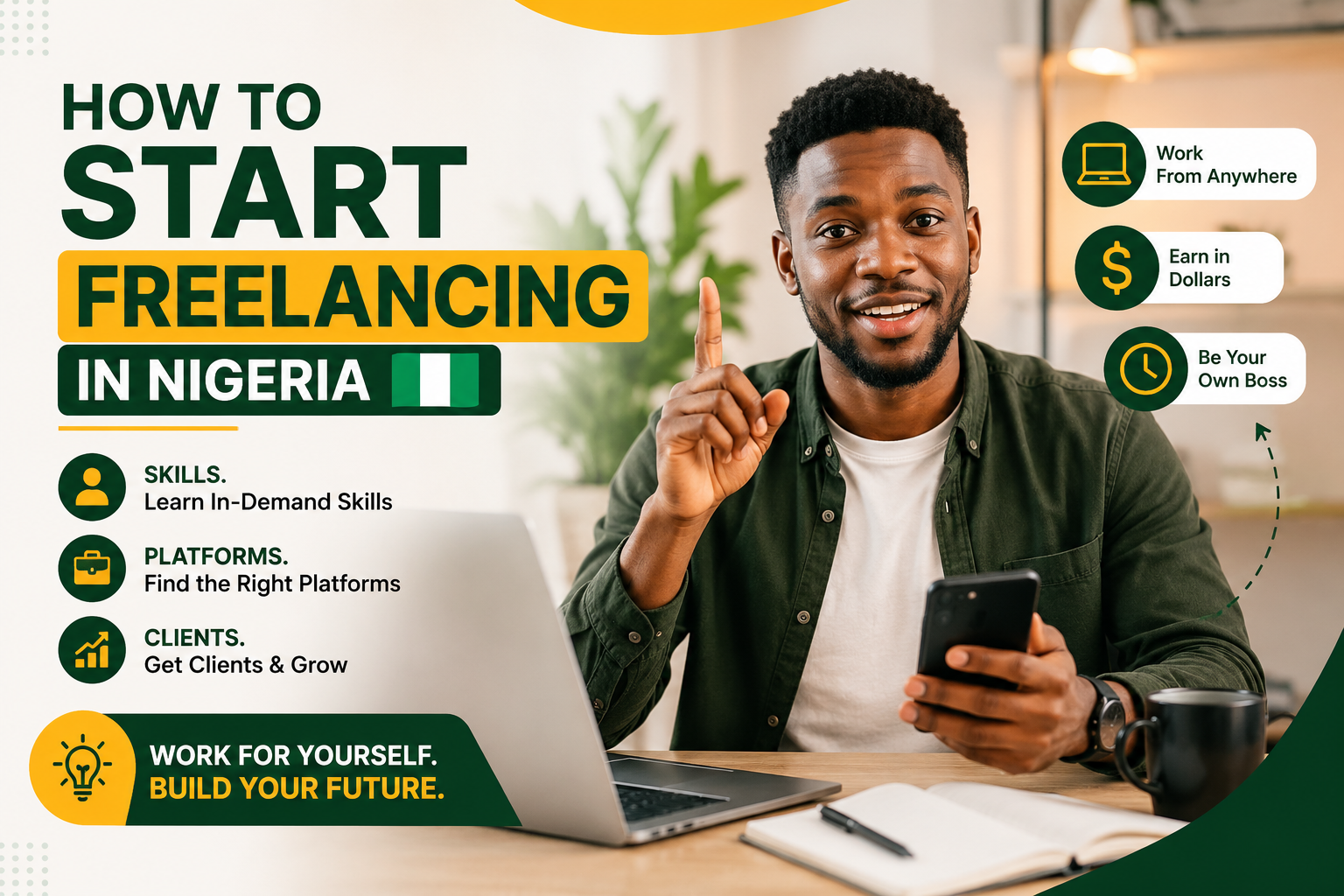
For many Nigerians, the internet has become more than a place to chat, watch videos, or scroll through social media. It has become a workplace.
Every day, thousands of people across Lagos, Port Harcourt, Abuja, Enugu, Kano, and other parts of the country are earning money online by offering services to clients they may never meet physically. Some work with businesses in Nigeria. Others work with clients in the United States, Canada, the United Kingdom, Australia, and other countries.
This is what freelancing is all about.
If you’ve been searching for how to start freelancing in Nigeria, chances are you’re looking for a realistic way to earn income online. Maybe you’re a student looking for extra income. Maybe you’re unemployed and need a skill that can generate money. Or perhaps you’re already employed but want an additional source of income.
The good news is that freelancing does not require millions of naira to start.
Many successful Nigerian freelancers began with nothing more than a smartphone, an internet connection, determination, and a willingness to learn.
But there is a catch.
Most beginners focus too much on creating accounts on freelance websites and too little on developing skills that clients are willing to pay for.
In this guide, you’ll learn exactly how freelancing works, the skills that are currently in demand, how to position yourself, where to find clients, how to receive payments in Nigeria, and the common mistakes that prevent beginners from succeeding.
By the time you finish reading, you’ll have a clear roadmap for starting your freelancing journey.
What Is Freelancing?
Freelancing simply means providing a service to clients without being employed by one company permanently.
Instead of working a traditional 9-to-5 job, freelancers work independently and get paid for specific tasks, projects, or contracts.
For example:
- A business owner may hire a freelancer to design a logo.
- A YouTuber may hire a freelancer to edit videos.
- A website owner may hire a freelance writer to create articles.
- A startup may hire a virtual assistant to manage emails and schedules.
Once the work is completed and approved, the freelancer gets paid.
Then the freelancer can move on to another project or continue working with the same client.
This flexibility is one of the biggest reasons freelancing has become popular globally.
Why Freelancing Is Growing Rapidly in Nigeria
A few years ago, most Nigerians believed earning online was nearly impossible.
Today, things have changed dramatically.
The combination of remote work, digital skills, artificial intelligence, global connectivity, and freelance marketplaces has created opportunities that didn’t exist before.
Several factors are driving the growth of freelancing in Nigeria:
1. High Demand for Remote Talent
Companies worldwide are increasingly hiring remote workers because it helps reduce costs.
Instead of maintaining large office spaces, businesses can hire skilled freelancers from anywhere in the world.
Nigerian freelancers benefit from this trend because many possess strong communication skills and can deliver quality work at competitive rates.
2. Low Startup Costs
Unlike opening a physical business, freelancing doesn’t necessarily require shop rent, equipment purchases, or large investments.
Many people begin with a smartphone and gradually upgrade to a laptop as their income grows.
3. Flexible Work Schedule
Freelancers often choose when and where they work.
This flexibility is especially attractive to students, parents, and people who already have full-time jobs.
4. Access to Global Clients
A freelancer in Port Harcourt can work for a client in New York.
A writer in Aba can create content for a company in London.
A graphic designer in Abuja can serve customers in Australia.
The internet removes geographical barriers.
Can You Start Freelancing With Just a Smartphone?
This is one of the most common questions Nigerians ask.
The answer is yes—but with limitations.
Some freelance services can be performed entirely on a smartphone, including:
- Social media management
- Virtual assistance
- Content creation
- Transcription
- Customer support
- Basic graphic design
However, as your freelancing career grows, investing in a laptop becomes important because it improves productivity and allows you to offer more advanced services.
Think of a smartphone as a starting point, not a permanent solution.
READ ALSO: How to make money online in Nigeria with your smartphone
The Best Freelance Skills to Learn in Nigeria
One of the biggest mistakes beginners make is signing up on freelance websites before learning a valuable skill.
Clients do not pay because you have an account.
They pay because you can solve problems.
Here are some of the most profitable freelance skills in Nigeria today.
Freelance Writing
Businesses constantly need blog posts, website content, product descriptions, and email newsletters.
If you enjoy writing and communicating ideas clearly, freelance writing can be an excellent starting point.
Many Nigerian writers earn in dollars writing for international clients.
Graphic Design
Businesses need logos, social media graphics, banners, flyers, and marketing materials.
Tools like Canva make it easier for beginners to get started.
Video Editing
The growth of YouTube, TikTok, Instagram Reels, and online courses has created strong demand for video editors.
Clients often pay premium rates for quality editing.
Virtual Assistance
Virtual assistants help business owners handle administrative tasks such as:
- Email management
- Calendar scheduling
- Customer support
- Data entry
- Research
This skill is often recommended for beginners because the learning curve is relatively manageable.
Social Media Management
Many businesses understand the importance of social media but don’t have time to manage it.
Freelancers help create content, schedule posts, and engage audiences.
Web Design
Businesses need websites.
Learning WordPress design can open doors to local and international opportunities.
Search Engine Optimization (SEO)
Website owners want more visitors from Google.
SEO specialists help improve search rankings and organic traffic.
This skill can be extremely valuable because businesses directly associate SEO with revenue growth.
| Freelance Skill | Difficulty Level | Startup Cost | Demand | Income Potential |
|---|---|---|---|---|
| Content Writing | Easy | Low | High | Medium to High |
| Virtual Assistance | Easy | Low | High | Medium |
| Graphic Design | Medium | Low | High | High |
| Video Editing | Medium | Medium | Very High | High |
| SEO Services | Medium | Low | High | Very High |
| Web Design | Medium | Medium | High | Very High |
| Programming | Hard | Medium | Very High | Very High |
If you’re starting from scratch, content writing, virtual assistance, and social media management are usually the easiest entry points because they require minimal startup capital.
Step-by-step how to Start Freelancing in Nigeria as a Beginner
The following steps are the best way to start freelancing in Nigeria:
1: Choose One Skill and Focus on It
Here’s a hard truth many beginners don’t like hearing.
Trying to learn everything at once usually leads nowhere.
Instead of learning writing, design, video editing, SEO, coding, and virtual assistance simultaneously, choose one skill.
Then commit to mastering it.
Imagine two people.
The first person spends six months learning graphic design deeply.
The second person spends six months jumping between ten different skills.
Who do you think is more likely to get clients?
The specialist almost always wins.
Focus creates momentum.
Step 2: Learn the Skill Properly
Once you’ve selected a skill, invest time in learning it.
You don’t need expensive courses immediately. There are plenty of free resources available online.
Watch tutorials, practice consistently, study professionals in your field, take notes, and build projects.
Most importantly, avoid the trap of endless learning.
Many aspiring freelancers spend years watching tutorials without ever offering services.
Learning matters. Practice matters even more.
If you’re learning content writing, start writing. If it’s graphic design, start designing. Learning video editing? start editing videos.
Skill grows through execution.
Step 3: Build a Portfolio Even Before Getting Clients
This is where many Nigerians get stuck.
They say: “How can I get clients without experience?”
The better question is: “How can I demonstrate my skills without waiting for clients?”
Your portfolio doesn’t need to contain paid work initially.
Create sample projects.
For example:
- A writer can create sample blog posts.
- A graphic designer can create fictional brand logos.
- A video editor can edit practice videos.
- A social media manager can create content calendars.
Clients want evidence.
A strong portfolio often matters more than certificates.
In the next section, you’ll learn how to create professional freelance profiles, where to find your first clients, how to receive payments from abroad in Nigeria, and the practical strategies that help beginners land their first paying project faster.
Step 4: Create a Professional Online Presence
At this stage, you have chosen a skill, learned the basics, and built a few sample projects.
Now comes the part that separates serious freelancers from everyone else.
You need to make it easy for potential clients to trust you.
Think about it from a client’s perspective.
If someone claims to be a professional writer, designer, or virtual assistant, but has no profile, no portfolio, and no online presence, would you confidently send them money?
Probably not.
This is why your online presence matters.
You don’t need a fancy website immediately, but you should have:
- A professional email address
- A complete LinkedIn profile
- A portfolio showcasing your work
- A clear profile photo
- A short bio explaining what you do
Your goal is simple: make strangers feel comfortable hiring you.
Create a Strong LinkedIn Profile
Many Nigerian freelancers underestimate LinkedIn.
They focus entirely on Fiverr and Upwork while ignoring one of the world’s biggest professional networking platforms.
Yet many clients actively search LinkedIn for freelancers.
Your profile should clearly explain:
- Your skill
- Who you help
- What results you provide
- Examples of your work
For example, instead of writing:
“Freelancer”
Write something like:
“SEO Content Writer Helping Businesses Increase Organic Traffic Through High-Quality Blog Content.”
Specific profiles attract better opportunities.
Step 5: Choose the Right Freelance Platforms
One of the fastest ways to connect with clients is through freelance marketplaces.
These platforms already have businesses looking for skilled professionals.
However, many beginners make a costly mistake.
They create accounts and immediately start sending proposals without optimizing their profiles.
A poorly completed profile rarely gets attention.
Take time to set things up properly.
Fiverr
Fiverr works differently from traditional job boards.
Instead of applying for jobs, you create service listings called gigs.
Clients search for services and hire freelancers directly.
How to Create a Fiverr Account That Actually Gets Clients
Creating a Fiverr account takes only a few minutes. Creating one that attracts buyers takes considerably more effort.
When setting up your Fiverr profile:
- Use a professional profile photo.
- Write a clear and specific profile description.
- Highlight measurable results whenever possible.
- Upload portfolio samples.
- Complete all profile sections.
For example, avoid writing:
“I am a freelancer.”
Instead write:
“I help businesses create SEO-optimized blog content that attracts more organic traffic and improves search visibility.”
Your first Fiverr gig should focus on one specific service rather than multiple unrelated services.
A focused gig usually performs better in Fiverr search results. Example of a Beginner Fiverr Gig
Gig Title: I Will Write SEO Blog Posts for Your Website
Description: Looking for well-researched blog posts that engage readers and support your SEO strategy? I will create original, reader-friendly content tailored to your audience and goals.
The clearer your offer, the easier it becomes for buyers to understand exactly what they’re purchasing.
Upwork
Upwork allows freelancers to submit proposals for available jobs.
Clients post projects.
Freelancers apply.
The client reviews applications and chooses the best candidate.
Winning jobs on Upwork often depends on:
- A strong profile
- Relevant portfolio samples
- Personalized proposals
- Client communication skills
Avoid sending copy-and-paste proposals.
Clients receive dozens of applications.
Generic messages usually get ignored.
PeoplePerHour
This platform connects freelancers with businesses seeking various services including writing, design, marketing, and programming.
Competition may be lower than some larger marketplaces.
How to Write an Upwork Proposal That Gets Responses
Many beginners lose jobs before clients even view their portfolios and the problem is usually the proposal.
Avoid generic openings like: “Dear Sir/Madam, I am interested in your project.”
Clients see this repeatedly so instead, address the client’s problem directly.
For example:
“Hi, I noticed you’re looking for an SEO content writer for your finance blog. I’ve reviewed the project details and believe the biggest opportunity is creating articles that rank for long-tail keywords while remaining engaging for readers.”
This immediately demonstrates relevance.
A strong Upwork proposal typically contains:
- A personalized introduction
- Evidence that you read the project details
- Relevant experience or samples
- A simple call to action
Keep proposals concise. Most clients spend less than a minute reviewing each application.
Freelancer.com
Freelancer.com offers opportunities across numerous categories including graphic design, content writing, software development, and virtual assistance.
Many beginners use it as an additional source of client opportunities.
READ ALSO: Best AI Side Hustles in Nigeria in 2026
Step 6: Find Clients Outside Freelance Websites
This is where many successful freelancers make most of their money.
They don’t rely solely on freelance platforms.
They actively look for clients.
Imagine a fisherman fishing, would he only cast one net into the ocean? Probably not.
The same principle applies to freelancing.
The more channels you use, the more opportunities you create.
Thousands of Nigerian businesses operate on Facebook.
Many struggle with content creation, customer engagement, and social media management.
If you can solve those problems, there are opportunities available.
Join relevant business groups.
Share useful insights.
Build credibility.
Avoid spamming people with sales messages.
LinkedIn Outreach
Many beginners wait for clients to discover them.
Successful freelancers often do the opposite.
They identify potential clients and start conversations.
For example, if you’re an SEO writer, you can connect with business owners, marketing managers, and startup founders.
Focus on providing value rather than immediately asking for work.
Cold Emailing
Cold emailing remains one of the most effective client acquisition strategies.
The idea is straightforward.
You identify businesses that could benefit from your services and send personalized emails explaining how you can help.
Many freelancers have built full-time incomes using this method alone.
How to Get Your First Freelance Client in Nigeria
Landing your first client often feels harder than landing your tenth because you have no reviews, no testimonials, and limited experience.
The solution is not to wait.
The solution is to create proof.
Here’s a practical roadmap.
Start Small
Many beginners aim for large projects immediately.
A better strategy is to secure smaller projects first.
These projects help you:
- Gain experience
- Build confidence
- Collect testimonials
- Improve your portfolio
Offer Value First
If you’re a social media manager, identify businesses with weak social media presence and suggest improvements.
As a writer, show examples of content ideas.
And if you’re a designer, create a sample concept.
People are more likely to hire someone who demonstrates capability.
Use Your Existing Network
Your first client may come from someone you already know.
Friends, family members, church members, business owners, and colleagues can become early clients or referral sources.
Don’t underestimate your network.
How Much Do Freelancers Earn in Nigeria?
There is no fixed salary in freelancing because earnings depend on skill level, client quality, and experience.
| Experience Level | Possible Monthly Earnings |
|---|---|
| Beginner | ₦50,000 – ₦200,000 |
| Intermediate | ₦200,000 – ₦700,000 |
| Advanced | ₦700,000 – ₦3,000,000+ |
These figures vary widely. Some freelancers earn less, while specialists working with international clients often earn significantly more.
READ ALSO: How to Earn Passive Income Online in Nigeria with no Money
How Freelancers Receive Payments in Nigeria
One concern many beginners have is receiving money from international clients.
Fortunately, payment options have improved significantly.
Many Nigerian freelancers use:
- Payoneer
- Grey
- Geegpay
- Wise (where available)
- Direct bank transfers
Different clients prefer different payment methods.
Before starting a project, always clarify how payment will be handled.
Never assume.
How Much Can Freelancers Earn in Nigeria?
This is the question everybody wants answered.
The truth is that freelancing income varies widely.
There is no fixed amount.
Your earnings depend on:
- Your skill
- Your experience
- Your niche
- Your communication skills
- Your ability to attract clients
- The value you provide
Some freelancers earn less than ₦50,000 monthly.
Others earn hundreds of thousands or even millions of naira monthly.
The difference often comes down to skill level and positioning.
A beginner charging ₦10,000 per project will naturally earn less than an experienced specialist charging ₦200,000 or more.
Focus on becoming valuable before obsessing over income.
Income tends to follow competence.
A Realistic Nigerian Freelancing Example
Imagine a university student in Port Harcourt with a smartphone and limited funds.
Instead of waiting for employment opportunities after graduation, the student learns content writing through free online resources.
After writing ten sample articles, they create a portfolio using Google Docs and LinkedIn.
They begin applying for freelance opportunities and reaching out to website owners.
The first client pays ₦20,000. The second pays ₦40,000.
Over time, referrals start coming in.
The student upgrades to a laptop and improves their skills.
A year later, they are earning more from freelancing than many entry-level jobs pay.
NOTE: This isn’t a guarantee. It’s simply an example of how freelancing often grows: one skill, a client, one project at a time.
Common Freelancing Mistakes Nigerians Should Avoid
Learning Too Many Skills at Once
Focus beats distraction.
Master one skill before expanding into others.
Competing Only on Price
Some beginners believe charging extremely low prices is the fastest way to get clients.
This often attracts difficult clients and creates burnout.
Compete on value, not just price.
Ignoring Communication
Many projects are won because of communication skills rather than technical skills alone.
Respond professionally, meet deadlines, and keep clients updated.
Giving Up Too Early
Perhaps the biggest mistake.
Some people quit after sending ten proposals. Others stop after a few weeks.
Freelancing rewards consistency.
The early stages can feel slow, but momentum builds over time.
A Realistic Freelancing Mindset
Social media sometimes creates unrealistic expectations.
You may see headlines claiming someone made thousands of dollars in a few weeks.
While such stories exist, they are not the norm.
Most successful freelancers built their careers gradually.
They learned skills, made mistakes, improved their portfolios, collected testimonials, refined their services, and stayed consistent.
Treat freelancing like a business rather than a quick-money opportunity.
The people who approach it seriously tend to stay longer and earn more.
Platforms to start your freelancing journey
Now that you have learnt exactly how you can start your freelancing journey, If you’re ready, the platforms below can help you learn skills, find clients, and receive payments from international customers.
Conclusion
Freelancing has opened doors for thousands of Nigerians who are willing to learn valuable skills and provide solutions to clients.
The opportunity is real, but success rarely happens overnight.
So, start with one skill, practice relentlessly, build a portfolio, create professional profiles, and market yourself consistently.
Your first client may take time. Your first dollar may arrive later than expected.
But every successful freelancer started exactly where you are now—at the beginning.
The most important step is not creating a profile. It is starting.
Frequently Asked Questions (FAQ)
Can students start freelancing in Nigeria?
Yes. Many students use freelancing to generate income while studying. The flexibility allows them to work around academic schedules.
Do I need a laptop before starting?
Not always. Some freelance services can be started using a smartphone. However, a laptop becomes increasingly important as you grow.
Can I freelance without experience?
Yes. Build sample projects and create a portfolio to demonstrate your abilities before securing paid work.
How long does it take to get the first client?
There is no universal timeline. Some freelancers find clients within weeks, while others take months. Consistency matters.
Is freelancing legitimate?
Yes. Freelancing is a legitimate way of earning income by providing services to businesses and individuals.